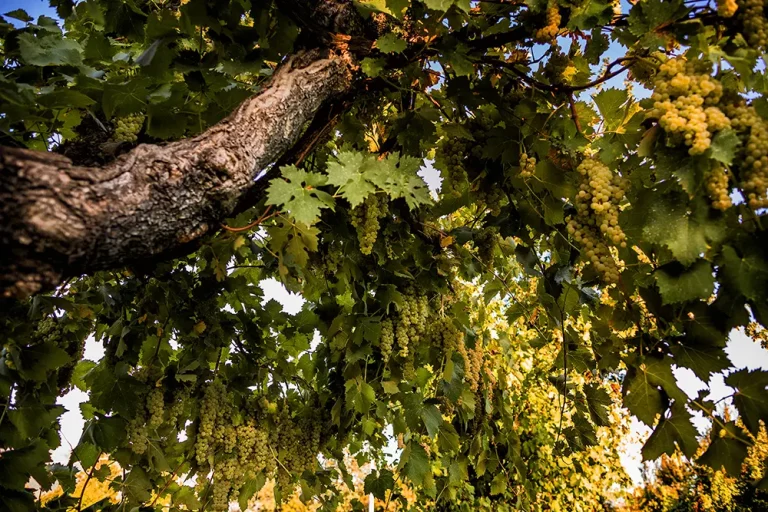
The announcement from the Consorzio Vini Montefalco, which protects the denomination, comes after the completion of the amendment process following the various institutional steps: board of directors, shareholders’ assembly, the Region of Umbria and the European Union. Producers have made a series of choices intended to update the wines of this specific PDO, based on Trebbiano Spoletino grapes, in line with a development plan launched in 2021 that immediately appeared to be a bold bet.
The main changes
In detail, the new production rules introduce the mention 'Trebbiano Spoletino Riserva', eliminating the 'bianco' type and the 'Trebbiano Spoletino Superiore' mention. The riserva must be obtained with at least 85% Trebbiano Spoletino grapes and up to 15% other white grape varieties authorised for cultivation in Umbria. Maximum yield per hectare is set at 11 tonnes. The previous altitude limitation for vineyards — which allowed plantings only up to 400 metres above sea level — has also been removed.
Another change, already operative like the others, is that both Trebbiano Spoletino and Trebbiano Spoletino Riserva may now undergo skin maceration. This measure is intended to enhance the ageing potential of the wine and achieve more intense aromas and flavours. This modification leads to an update of the colour description: from straw yellow to deep golden yellow, the Montefalco Consortium explains, in line with the deeper tones that maceration can impart.
The territorial mention 'Umbria' arrives
Wine producers will also be able to include the territorial mention 'Umbria' on labels. As in other Italian regions (such as Piedmont, which introduced it on a voluntary basis), this choice “reinforces the identity bond with the region and confirms producers’ intention to present themselves on national and international markets as ambassadors of a territory unique for its history, vocation and the quality of its wines,” writes the Consorzio Vini Montefalco in an official note.
“We are very satisfied with the cohesion shown by all members,” said president Paolo Bartoloni, “which allowed us to quickly implement such important changes and to continue working decisively on the next steps.”
Working to expand the production area
Those next steps concern the production zone. The board of directors and assembly of the Perugia-based body are initiating the process for a new amendment to the Spoleto DOC production rules. The aim is, specifically, to expand the production area by extending the denomination to territories already authorised for Montefalco DOC and Montefalco Sagrantino DOCG.
A “significant” step that, according to the consorzio, will make it possible to produce Spoleto DOC also in some of the municipalities previously excluded: Bevagna, Gualdo Cattaneo and Giano dell’Umbria.
The objective is to strengthen the bond between denominations and offer new perspectives to producers in the Montefalco Sagrantino DOCG and Montefalco DOC areas, who will have the opportunity to enhance the many expressions of Trebbiano Spoletino, which is experiencing “strong growth both in terms of quality and market appreciation.”
In the final period of 2025, coinciding with the holiday season, the consorzio estimated total consumption of wines from local cellars at nearly one million bottles.
This is not the only upcoming wine labelling change in Umbria – from harvest 2026 onwards, producers around Lake Trasimeno will be permitted to officially call their 'Gamay' 'Grenache'.
 'Sustainability is not an abstract term'
 Trebbiano Spoletino changes colour
 Why not every trattoria should be written about
 Brigitte Bardot’s final rosé: the wine that marks the end of an icon
 What you need to know about Italy's new decree on dealcoholised wine