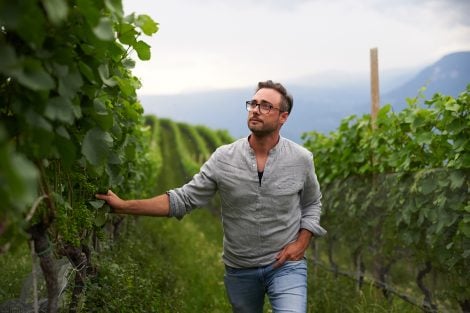

"What has remained constant over four generations is a deep respect for our land and for wine as an expression of place rather than technique. My ancestors worked with intuition and experience; they listened closely to the vineyard, even if they didn’t use the language of sustainability or precision viticulture that we use today," says winemaker Alessandro De Stefani, whose great-grandfather Valeriano De Stefani began cultivating vines in this corner of Veneto in 1866.
"What has changed is the level of awareness and responsibility. Today we have more scientific knowledge, better tools, and a clearer understanding of our impact on the environment," he continues. "This allows us to be more precise and, in many ways, more respectful. Our philosophy has evolved toward organic farming, lower intervention, and transparency, but the core values — patience, authenticity, and quality over quantity — are exactly the same."
Climate change
This philosophy is proving to be highly important in the context of a changing climate, something which De Stefani says makes him "concerned, but not passive".
"Climate change is already reshaping how we work in the vineyard, and the entire wine industry must adapt. The challenge is to do so without losing the character that defines our wines and our region," he explains.
Indeed, the De Stefani estate is far from passive when it comes to doing what it can to help its vines.
"At De Stefani, we focus on organic farming, healthy soils, and biodiversity, because resilient vineyards start from the ground up. We manage canopy growth carefully, harvest earlier when necessary, and avoid over-ripeness. We also limit irrigation and energy use and continually reassess our practices to reduce our environmental footprint. For us, sustainability is not a marketing concept — it’s essential for the future of our estate."
Rive di Refrontolo
One asset that De Stefani has in its efforts to maintain freshness and lightness in the face of warmer growing seasons is the terroir of one of the areas where it cultivates Glera, the signature variety of Prosecco.
"The Conegliano Valdobbiadene appellation is divided into 43 different zones, called 'Rive'. They are the same as the Cru in France. The Refrontolo Rive is the one in the heart of this UNESCO World Heritage territory. It has a mild climate, at the foot of the Dolomites and the soil is calcareous and rich in marl," explains De Stefani.
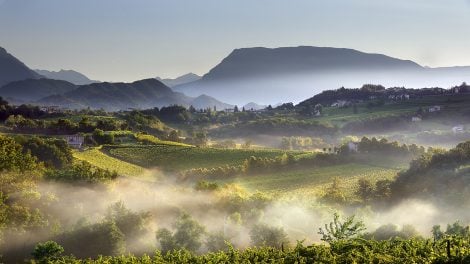
The mildness of the climate of Refrontolo, which is situated between 200 and 350 metres above sea level, is certainly an asset for viticulture during hot summers.
"The combination of altitude, exposure, and constant air movement helps preserve freshness and balance in the grapes, even in warmer years. It allows for slower, more even ripening, which is increasingly important today," says De Stefani.
"That said, climate change affects every region, even those with favourable conditions," he shares. "The advantage of Refrontolo is not immunity, but flexibility — it gives us more options in terms of harvest timing and vineyard management, which helps us maintain quality and identity."
Rive di Refrontolo Valdobbiadene Prosecco Superiore
The embodiment of this identity is in De Stefani's Rive di Refrontolo Valdobbiadene Prosecco Superiore, an Extra Brut expression of the territory, and of careful vineyard management, including summer pruning of the vines.
"Summer pruning is very important, since it stimulates the generation of new shoots, called 'femminelle'. They contribute in creating a higher number of leaves, which is an important engine for sugar, acids and aroma creation. Furthermore they protect the grapes for excessive sun, maintaining the flavours and freshness of the grapes."
De Stefani must also be careful when it comes to harvesting the Glera grapes: too early and it will taste austere and green, too late and it will be high in alcohol and lack that acidic backbone that good sparkling wine needs.
"The key is balance rather than chasing ripeness. Vineyard work, harvest timing, and grape selection are critical, and we are very attentive to acidity and freshness rather than sugar alone," he notes. "We try to harvest grapes at the right ripening moment, having a balanced acidity, a good body and a good mineral level. In this way a lower residual sugar is perfectly integrated with the bubbles and the vitality of this Prosecco."
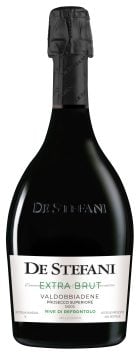
The Rive di Refrontolo Valdobbiadene Prosecco Superiore comes in at an ABV of between 11% and 11.5%.
"Lower alcohol wines require discipline and experience, but they also reflect our philosophy: wines that are elegant, drinkable, and expressive of their origin. In warmer seasons especially, restraint becomes a virtue," says De Stefani.
The evidence of De Stefani's light touch when it comes to winemaking is in the glass.
"It has purity, elegance and character. This Prosecco stands out because on the intensity of its flavors and the finesse given by the combination of acidity, minerality and lightness," he says. "It is fantastic as an aperitif on its own, or with seafood and delicate fish dishes."
 'Old vines are a fundamental part of the identity of this wine'
 The Italian restaurant inside a clothing factory in London
 Equalitas, exports and breaking the rules – why Casale del Giglio works
 'You have to let British people fall in love with Italy'
 Why ABFV Italy chose a quarry for its new Bolgheri winery