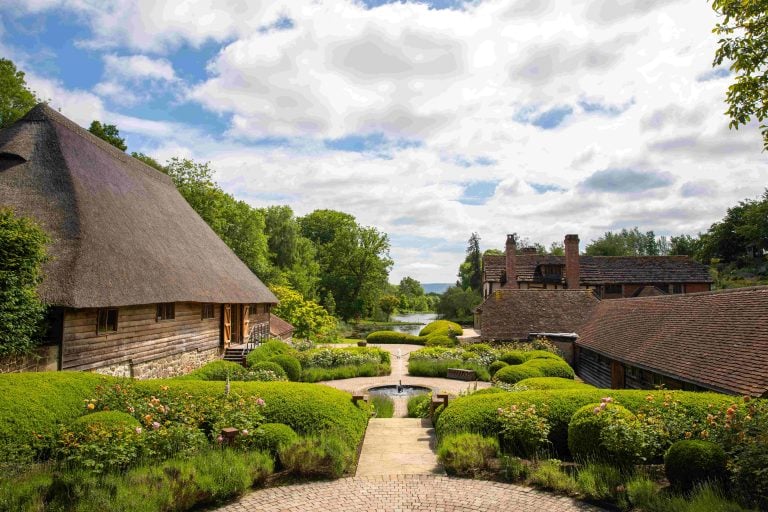
"We’re definitely not a flash in the pan! We’ve never compared ourselves to Champagne, we make our own style, we do our own thing," says Sam Lindo, second-generation winemaker of Camel Valley, a wine estate founded by his parents, Bob and Annie Lindo, in Cornwall in 1989. "There are similarities with Champagne in terms of climate, and that’s what got us off the ground. But with climate change we’re moving to where Champagne was 30 years ago, and Champagne is changing."
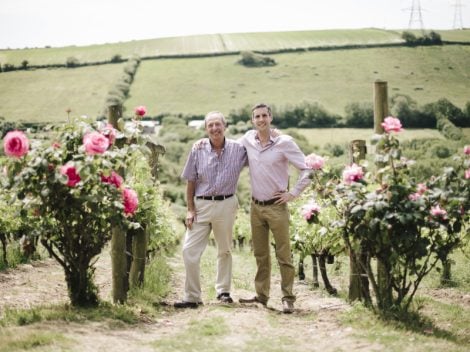
Camel Valley's Bob and Sam Lindo
Comparisons with the famous French sparkling region are inevitable: some big brands such as Kent-based Chapel Down use blind tastings of their wine against Champagne for viral publicity stunts, and some houses including Louis Pommery and Taittinger have invested in vineyards on the other side of the Channel. But although there are similarities in terroir and technique, English sparkling wine isn't simply aping Champagne, instead it is developing its own distinctive identity.
Protected Designation of Origin
Although grapes are cultivated across the southern half of England – from Cornwall in the West to Norfolk in the East – production is concentrated around the South Coast, especially in the counties of West Sussex, East Sussex and Kent.
The former two of these made quite a splash in the English wine scene 2022 when 'Sussex Sparkling Wine' became a protected term in the UK. In order for a wine to be labelled as such, it must be made solely from grapes grown in Sussex, produced using the traditional method, and aged on the lees for at least 15 months.
One of the wineries to spearhead this was Rathfinny Estate, a grower-producer of solely vintage sparkling wines, based on Pinot Noir, Chardonnay and Meunier.
"The PDO is more important in international markets than in the domestic market. I think a lot of that is because you can point at somewhere on a map and say ‘that’s Sussex, that’s where we come from’," says estate co-founder Mark Driver. "When we present overseas, we present a map with wine growing regions they will know, like Champagne and Burgundy, and when you show Sussex, it shows how close we are, as the crow flies. It gives people a picture of our region, and because they see we’re by the sea, you can then talk about how we have a semi-maritime, semi-continental climate."

The view from Rathfinny Estate's vineyard.
The process of securing the Sussex Sparkling Wine PDO took the best part of a decade, and a great deal of paperwork.
"When we visit Europe, everyone understands PDOs, and they’re impressed because they understand how difficult they are to get," shares Driver. "It puts us in context, you get a sense of what they are and how they should taste."
However, the idea of introducing wine PDOs along county lines is not without its sceptics.
Among them is Henry Jeffreys, writer of the award-winning book Vines in a Cold Climate: The People Behind the English Wine Revolution.
"West Kent is very similar to East Sussex – they’re historical counties, it’s nothing to do with terroir," he remarks. "PDOs are important in the export market, they mean something to buyers in Norway’s monopoly who will have a space for a Sussex sparkling. But, they will never mean anything to customers, they’ll be like those DOCs in Italy that no-one has ever heard of. It’s a huge amount of bureaucracy."
International exports
When it comes to export markets, English wine is definitely gaining traction, regional PDO or not.
"Building on export growth of 35%, WineGB has engaged with international markets, we took more than 150 English and Welsh Wines to Europe, representing more than 50 producers at events and venues including ProWein and Wine Paris, Helsinki and Copenhagen Embassies, and UK Mission to the EU in Brussels," says Nicola Bates, CEO of WineGB, the body representing British wine producers. "WineGB will be at Wine Paris again in February with 16 producers, and this reflects the growing interest we are seeing from overseas."
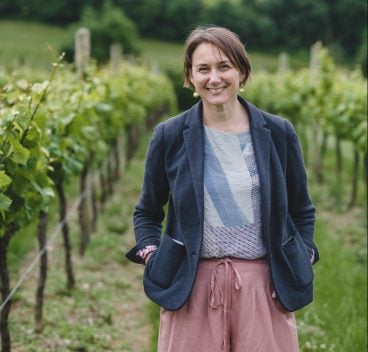
WineGB CEO Nicola Bates
Among the brands to have developed a big international profile is Nyetimber.
Karl Thogersen, Nyetimber's head of sales for Europe & Global Travel Retail, reveals that the producer's wines are currently sold in 23 international markets, with the major ones being Norway, Germany and the United Arab Emirates (UAE).
"Norway is the largest market for English sparkling wine overall, and we are seeing impressive results for Nyetimber in this country," he notes. "It helps that Norwegian cuisine is well-suited to our style of wines, with their fresh flavours and high acidity pairing beautifully with seafood."
"Germany is also one of the biggest sparkling wine markets when you look at consumption per capita. There has been a rise in premiumisation in the country which has led to people seeking out higher quality sparkling wines, such as Nyetimber," he continues. "In terms of the UAE, this is very much a luxury market for which Nyetimber is very well suited. The UAE also has a high number of British expats, which helps with brand awareness in the region, and in turn, sales – as consumers are keen to have a taste of home away from home."
Norway is also a good market for Rathfinny, where it is distributed by Haugen-Gruppen, which also handles tea brand Twinings.
"We do a lot of afternoon tea collaborations with them – we’re poured at some of the top hotels and restaurants in Oslo and Bergen," says Driver.
The Norwegian market also buys some of the Rathfinny Mini – a 50cl bottle of traditional method Sussex Sparkling Wine which undergoes secondary fermentation in the bottle. Due to certain European regulations, this small format cannot be sold in the EU, the irony being that the half-litre bottles are manufactured in Italy.
Another international destination for the Rathfinny Mini is Japan, where a "few hundred bottles have been sent to test the waters".
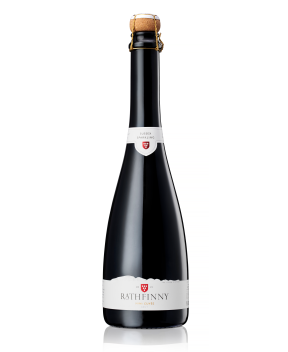
The Rathfinny Mini
"Japan has a huge number of Michelin-starred restaurants, but a lot of them only have a very small number of covers, therefore these half litre bottles are the perfect size to be shared by two people for a meal – it also fits the modern mantra of ‘drinking less but better’," suggests Driver.
There is another, more unusual reason why Sussex Sparkling might do particularly well in Japan.
“When we went to Japan and we started talking about Sussex, the Japanese weren’t particularly aware," shares Driver, "but we then showed them where Brighton was in Sussex, and they all know Brighton because of Brighton & Hove Albion footballer Kaoru Mitoma, who is also probably the Japanese footballer who has played the most in the Premier League."
Driver also believes that one other international destination where the English fizz category could carve out a niche is a country known for its sparkling wine production – Italy.
"We work with a distributor, Zafferano, in Brescia," he says. "I think English sparkling has a good chance in Italy because they are very knowledgeable about sparkling wine, because of course they produce a lot of it, but they tend to export it and import a lot of Champagne. There’s a real recognition of the quality of English wine, and there’s scope to expand in Italy – we don’t just make great whisky and gin!"
Partnerships
One indication of English sparkling's commercial success is the number of commercial partnerships producers are involved in.
For Rathfinny Estate, one such example is its collaboration with Norwegian cruise liner Hurtigruten, which involved ageing bottles of the Sussex producer's Classic Cuvée 2018 under the sea, just on the edge of the Arctic Circle. The unique wines were then raised to the surface and were made available for sale on Hurtigruten vessels.
Kent-based Chapel Down, the biggest wine producer in England, has sponsored a number of major British sporting events, including the Boat Race between the universities of Oxford and Cambridge, and the Royal Ascot horse race.
Also getting involved in the sporting action is Nyetimber, which was announced as the Official Sparkling Wine Partner of England Rugby this September. Nyetimber also sponsors British Cycling and events such as the Henley Royal Regatta and those of the LTA (Lawn Tennis Association).

Nyetimber's Land Rover
"Our sponsorships and partnerships are hugely important to us as they allow us to reach new audiences and place Nyetimber in the heart of British culture," says Thogersen. "Of course, these are primarily targeted towards a domestic audience; however, they are all aspirational and therefore attract an international audience as well – whether on the ground or via broadcasting. In some cases, these events provide the first opportunity for visitors to try Nyetimber for the first time, and we often find that once people have sampled Nyetimber, they tend to come back for more!"
There is another form of partnership which also carries a great deal of prestige in the UK – holding a Royal Warrant, meaning that a product is supplied to the British Royal Household. Camel Valley is listed as a "purveyor of English sparkling wines" to both King Charles III and Queen Camilla.
"It's a lovely thing to get – it has trumped any PDO," remarks Lindo.
Has it reached its peak?
English sparkling wine has largely shed its reputation as a 'novelty' and a 'curiosity', though it is still a youthful compared to its European counterparts.
"We are very much a young category compared to Champagne and Prosecco, but this brings the excitement of something new. English sparkling wine offers a real point of difference with exceptional producers to explore, all with wonderful stories to tell. Most importantly, the quality is just getting better and better," argues WineGB's Bates.
However, while English sparkling wine is steadily but surely gaining global recognition, there are those who think that the industry may have reached its greatest extent in terms of the number of vineyards, now in excess of 1,000 across the country.
“I don’t know how much bigger it can get," suggests Jeffreys. "It’s definitely in the retrenchment phase, to put it diplomatically. There are a lot of people who aren’t making much money from it, are financially hard up. I would be very surprised if, in terms of vineyard area if not production, it didn’t start to slow down or even contract. A lot of people poured money in during the crazy zero interest years, but now, unless you have a very rich patron or are very clever, then a lot of these businesses are not financially viable."
What we may start to see in the coming years is a process of consolidation whereby some of the more mid-sized producers are, in Jeffreys' words, "swallowed up if they can't make any money".
What's next?
Although this may seem to be a worrying forecast, Jeffreys expresses a belief that the "long-term future of English wine is bright".
“The quality is still extremely high, and getting better the whole time, especially with things like still wines from Essex, which would have been unimaginable 10 years ago," he says.
Climate change might be causing headaches for wine growers across Europe each growing season, with concerns about how vines will struggle in the heat, but for English producers it presents an opportunity. Warmer vintages mean that ripeness of the grapes is less of a struggle, enabling the production of wines that seemed inconceivable just a couple of decades ago – acclaimed still Pinot Noir, award-winning Sauvignon Blanc, even thicker-skinned red varieties such as Cabernet Franc and Syrah are now being planted in small quantities.
Precisely how the coming years will shape England as a wine region remains to be seen. To paraphrase the epic Anglo-Saxon poem Beowulf: its fate is unknowable, but certain.
 Equalitas, exports and breaking the rules – why Casale del Giglio works
 'You have to let British people fall in love with Italy'
 Why ABFV Italy chose a quarry for its new Bolgheri winery
 Casa Vinicola Coppi pays tribute to its founder with forgotten grape variety
 How ultraviolet rays can improve wine