
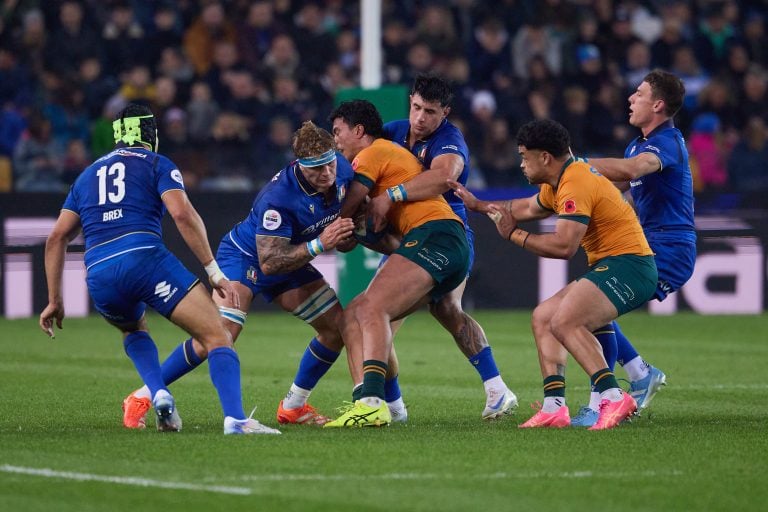
"Nutrition certainly plays an important role in optimising performance and recovery. The fact that the players are more attentive to what they eat and when they eat can help them perform better on the pitch," says Alessio Montagnoli, nutritionist for the Italy national rugby union men's team.
Since Montagnoli began his work with the Federazione Italiana Rugby at the start of 2024, the team has notched up some impressive wins. While tactics and training have certainly played a role in the improvement on the pitch, the value of nutrition should not be understated.

Alessio Montagnoli
"Since I arrived, we have established daily menus for the squad, based on two first courses (one of which is always gluten-free) and two main courses (generally one meat and one fish), plus a buffet of raw, cooked and grilled vegetables, and a buffet of fresh fruit," explains Montagnoli. "Depending on the day and the training schedule, we might also add an additional choice of grains, a soup or vegetable purée, legumes, and other specific dishes."
Pre-match preparations
There is no precise figure for how many calories each player ought to consume before a big match: "Each player has a specific caloric requirement based on their weight and anthropometric characteristics."
"What is certain," he continues, "is that pre-match nutrition focuses much more on carbohydrates, and we try to reduce the intake of fats and fibre to ensure optimal digestion when the players take to the field."
One particular source of carbohydrate powers the Italian squad.
"On average, around five kilograms of pasta are consumed at each meal, not including other grains and other sources of carbohydrates," he reveals. "Pasta, being a good source of complex carbohydrates, is an excellent food for professional athletes. Naturally, each player has their own preferences, and they don’t always choose pasta as their carbohydrate source."
Montagnoli does not believe that certain foods have to be avoided by the players at all costs.
"In general, no food should be demonised," he argues. "Obviously, depending on timing and proximity to a training session or match, food needs to be an effective source of energy and should not slow down digestion or cause gastrointestinal discomfort."
When the team is touring, there will be some deviation from Italian cuisine: "When we travel abroad, it is important to use the products and culinary traditions of the host country as well."
Although a varied diet is key for the players during training camps in the weeks before a game, with Montagnoli endeavouring to "never repeat dishes", one vitally important rule that must be adhered to is that there should be no surprises on the menu in the immediate buildup to a match.
"The days leading up to a match follow a fixed menu which includes the options I mentioned previously. It is important that the menu is more or less always based on the same structure, because from two days before a match onwards, you shouldn’t experiment or introduce new dishes. This applies both for nutritional and digestive reasons, and for the players’ eating habits."
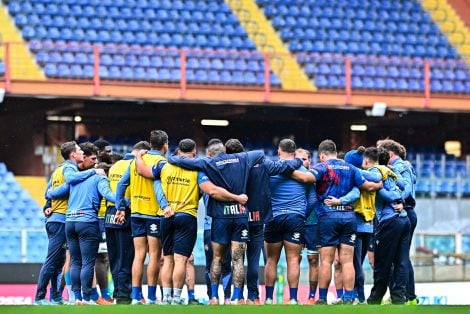
Photo by Simone Arveda - Federugby/Federugby via Getty Images. Provided by the FIR.
"The night before a match we have a fixed menu for each training camp, always consisting of two choices of first course and two of main course, without going into too much detail. We also add certain buffet items which help optimise performance the following day," says Montagnoli.
"Breakfast depends on the match time and on whether there will be another meal afterwards. The foods most commonly eaten are eggs, low-fat yoghurt, bread and cereals."
Post-match celebrations
Tackling the issue of whether or not players are permitted to celebrate a good result, or mourn a bad one, with a pint of beer or a glass of wine, Montagnoli says: "This isn’t my responsibility to decide."
Drinking is a part of rugby culture, for both the fans and the players, and Montagnoli suggests that while it might not be nutritionally advisable, some traditions are allowed to endure: "I can say that alcohol has a negative effect on recovery and performance, but at the same time rugby has its traditions, and in those moments I think it’s right to be flexible and allow the players to relax and enjoy an important social moment."
 Why ABFV Italy chose a quarry for its new Bolgheri winery
 Casa Vinicola Coppi pays tribute to its founder with forgotten grape variety
 How ultraviolet rays can improve wine
 What is Ormeasco?
 The role mapping played in the creation of one of Alto Adige's best Sauvignon Blancs