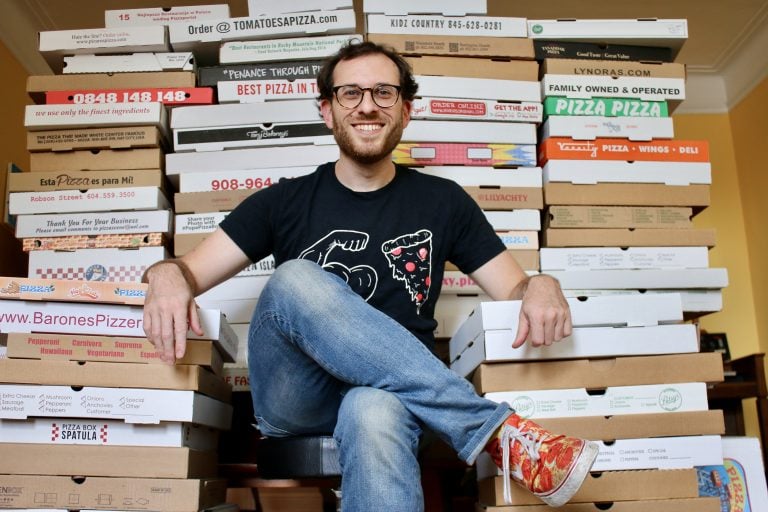
Holder of the Guinness World Record for the world's largest pizza box collection, a professional tour guide of the pizzerias of New York City, and a pizza writer, presenter and pundit, Scott Wiener is a leading authority on everything dough, sauce and cheese.
"I got into pizza because of the adventure aspect of pizzerias, they were like my mini museums, tapping into a specific time and place," he explains. "The conversation about who has the best pizza is very personal, but in my view there’s an objective lens for everything – I want to get down into why things are the way they are, it became a lesson in history and science and culture, more than just food. I can never choose a favourite because they all have different intentions."
Founded by Wiener in 2008, Scott's Pizza Tours takes guests around New York pizzerias, exploring those which are historically significant, offer different styles, or just serve a great slice.
In almost two decades of running these tours alongside a cohort of fellow "pizza nerds", Wiener has noticed how social media has changed things.
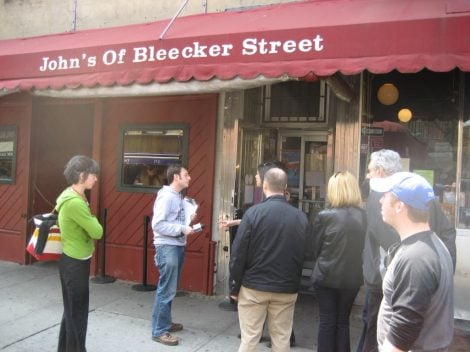
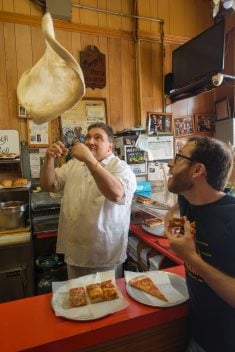
Scott in the early days.
“Social media and our ability to see what’s happening in other places has transformed food tourism and added to this idea of experiences being the value proposition of travelling. You can see what people are eating in New York or London or Sydney, and you can make a decision in advance. Running pizza tours for the past 18 years, I’ve seen that there are more intentional travellers, people who have gotten into pizza making themselves and have a specific hit list of pizzerias, not just wherever’s across the street," he shares.
He also notes that pizza, unlike other food categories, is perfectly geared towards becoming a hobby, and for people of all ages.
“It’s low cost and high interaction. If you’re obsessed with making the perfect T-bone steak, you can’t do that every weekend for two years, but with pizza you can. There’s also so many variables to control – it’s the perfect food for nerds. On a recent tour I gave there was an 11-year-old kid from Auckland, New Zealand who, within six minutes of it starting, asked about the hydration of a dough!”
Bending the rules
It isn't just the hobbyists who are experimenting – Wiener notes that pizzaiolos/pizzaioli across the globe are pushing the envelope further and further.
“Taboo breaking is the theme of the past year. All these things that people have been so happy to argue about, we see the Italians adding to their menus. Once it happens in Italy, it feels like everyone’s been given the ‘ok’. Even in Naples, there’s a whole new generation of pizza makers who are excited about ignoring the rules of the past. If that’s happening in Naples, it can happen anywhere,” he remarks.
While Italian cuisine was recently recognised by UNESCO, Wiener notes that an "authentic" recipe is usually a static look at something which is far more fluid.
“When you leave the place of origin, you take with you an idea of purity from the time when you left that place, and then, very quickly, that place moves on without you and you don’t get the memo. In New York there are all these places that see themselves as very ‘authentic’, but they’re authentic to a very particular time, and that time was like the 1910s – it’s a snapshot of a memory. At this point, the name of the game is freedom from all that stuff. If you’re living in a place with an immigrant population that came over at a very specific time, the culture that they keep is of that time.”
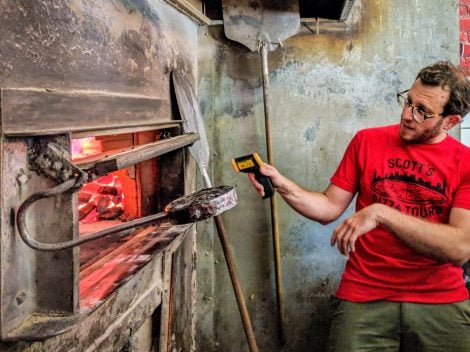
Taking the temperature. Image credit: Dale Cruse.
Attitudes have changed as the concept of pizza itself has changed.
“Until five or 10 years ago, the concept of what New York pizza was was limited – it was the basic same flour, tomatoes and shredded mozzarella bought from the same suppliers. Now that definition has broadened. Globally, pizza is approached as another bread, rather than as a separate thing that must be made in a certain way," argues Wiener. "Pizzerias in New York think more about fermentation now. It’s also no longer a necessity to have grease sliding down your arm when you eat a New York slice!”
New trends
One ingredient which seemed to dominate the internet in the last 12 months was hot honey, which is honey that has been given a spicy kick with the addition of chilli and, sometimes, some vinegar.
That combination of sweetness and heat complements pizza well, and that is why it has become a worldwide phenomenon at pizzerias, though the fervour has perhaps passed in its place of origin, with hot honey now simply considered a normal pizza addition.
"The hot honey craze really started in New York, and it has not elevated in the past year, but has blown out of New York in the last year. 2025 was the year when hot honey became expected, rather than being seen as a speciality – at every new place, you know there will be a pizza with hot honey on it, and if you want it drizzled on a slice, you can probably get it. It has joined the ranks of the chilli flakes and oregano on the table," says Wiener.
New York City's pizza scene might be about to change with regards to the emergence of places selling more regionally-specific Italian pizza styles, and there are two in particular which Wiener thinks could do well in the Big Apple.
“Sfincione [the thick, square pizza from Palermo typically topped with anchovies and onions and a small amount of cheese] is available in some places if you know what you’re looking for, but it hasn’t quite caught on. I hope that a year from now there will be an explosion in that product because I think it scratches a particular itch for a lot of people: lightness, levity – people love contrast. I think Roman pizza tonda [round, thin-crusted pizza from the Italian capital] is going to happen in New York soon, because people like a ‘sit down’ pizza, and I think people have become a bit tired of Neapolitan pizza because they have tried a lot of bad examples."
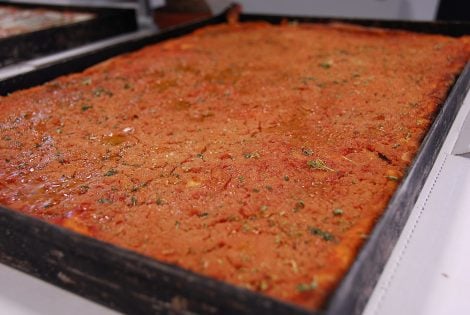
Sicily's Sfincione. Image credit: Rino Porrovecchio.
"In New York, most of the new places are Neapolitan pizzerias, but the margin for error with that style is so slim that a lot of them have cascaded into being a slightly different style," he continues. "I think it’s way more forgiving to make something like tonda Romana because the window of opportunity in a lower-temperature oven is wider – it’s also almost half the amount of dough, which means that out of the same bag of flour you can get double the number of pizzas. Right now, the name of the game is food cost."
As rich as pizza culture is in Italy, across the Atlantic it has continued to develop and evolve, with numerous regional variations across the US: 'deep dish' and 'tavern-style' in Chicago, 'apizza' from New Haven in Connecticut, the focaccia-esque pizza of Detroit. Regarding the latter, which seems to have suddenly gained international recognition thanks to social media, Wiener notes that though its abundance of cheese and toppings have a certain appeal, there is one big drawback for this style from the great state of Michigan.
"Detroit style is popping up more and more, but it’s a little tougher because New York is really a city of portability. If you can’t carry the pizza, it’s a harder sell. Some places have opened that offer Detroit style pizza by the slice, but I think the bigger momentum is going toward the really nice slice shop, or high quality Roman, neo-Neapolitan, 12-14 inch diameter pizza."
Economics and politics
Visitors to New York might end up falling into some of the city's tourist traps, and when it comes to pizza that must surely be the widely-advertised 'dollar slice'. Inflation has meant that finding a portion of pizza that still costs US$1 in NYC is almost impossible, though Wiener suggests that this was a fool's errand to begin with.
"I don’t think it was ever possible to get a good dollar slice in New York. It became a tourist attraction because you’re in an expensive city with an inexpensive food, but I would argue that buying five dumplings for US$2 is a way better use of a small amount of money than getting one of those slices."
The fact that New York is both highly desirable to live in and incredibly expensive raises questions about whether smaller businesses, such as pizzerias, are being pushed out by the gentrification of neighbourhoods, but Wiener disputes this.
"I wouldn’t frame it with that word, as it implies that you’re pushing one thing out by displacing it with another. I think what we’re seeing in New York is more of a broadening of the market – instead of there being 10,000 people regularly seeking out pizza, it’s gone to 15,000. I think the new pizzerias are taking more away from restaurants than they are from existing pizzerias. The pie isn’t getting cut up smaller, it’s getting bigger."
New York could be about to undergo some big changes thanks to the election of Zohran Mamdani, the new Mayor of New York City who was inaugurated on 1 January. Asked whether he thinks Mamdani will be good for the city's pizzerias, Wiener gives an unequivocal "yes".
"He is very much someone who appreciates simplicity and street food and has positioned himself as a champion of working people, and pizzerias, even at the highest level, are still very much restaurants for and by working people. He’s more likely to be understanding of the street cart and the slice shop as embodiments of New York’s culture, and pizza by the slice absolutely embodies the pedestrian culture of New York City."
"In the past we have had mayors who were more interested in flaunting a high level of what they deem as success," he adds. "Zohran is also younger, and pizza is the food of youth – it wasn’t that long ago that all you could afford as a kid growing up in New York City was a slice of pizza."
 What is Ormeasco?
 The role mapping played in the creation of one of Alto Adige's best Sauvignon Blancs
 'Campo de’ Fiori is no longer a market': The transformation that no one talks about
 'Excellent products will remain excellent' – but does Old World wine have to adapt to survive?
 Why 'the rules are still being written' for non-alcoholic drinks