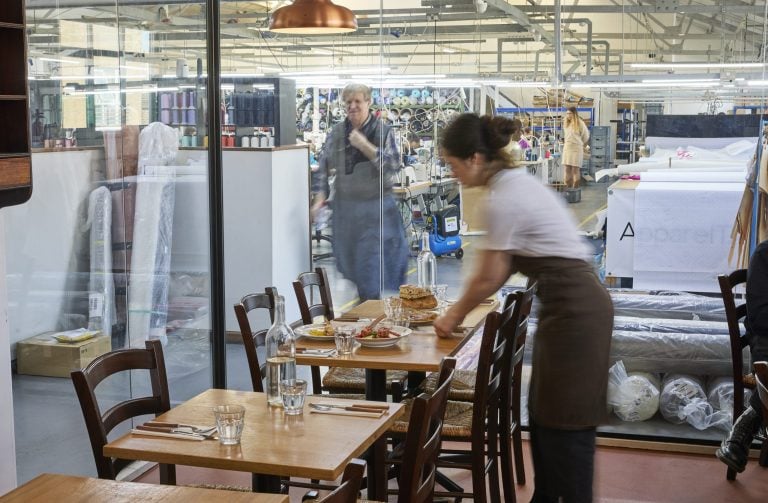
Walking through an industrial estate is not how most memorable meals in London begin, but then again Polentina is very different from most restaurants.
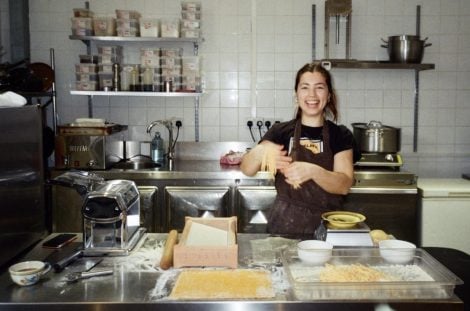
"It can be difficult for walk-ins, but we do get them," says Sophia Massarella, who opened the restaurant in Bow during the dark days of the Covid-19 lockdowns.
“I was a photographer and all the studios were shut so I couldn’t find any work. So my partner Zack and I had the idea to start a food truck just serving polenta, but that fell through because we couldn’t get the truck. So then I rented a ‘dark kitchen’ down the road from a friend, doing Deliveroo and Uber Eats, but it was a bit frustrating because there was no relationship with the customers."
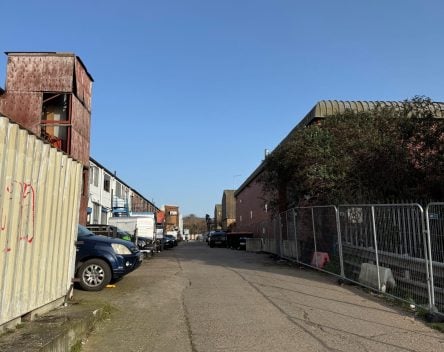
The route to Polentina.
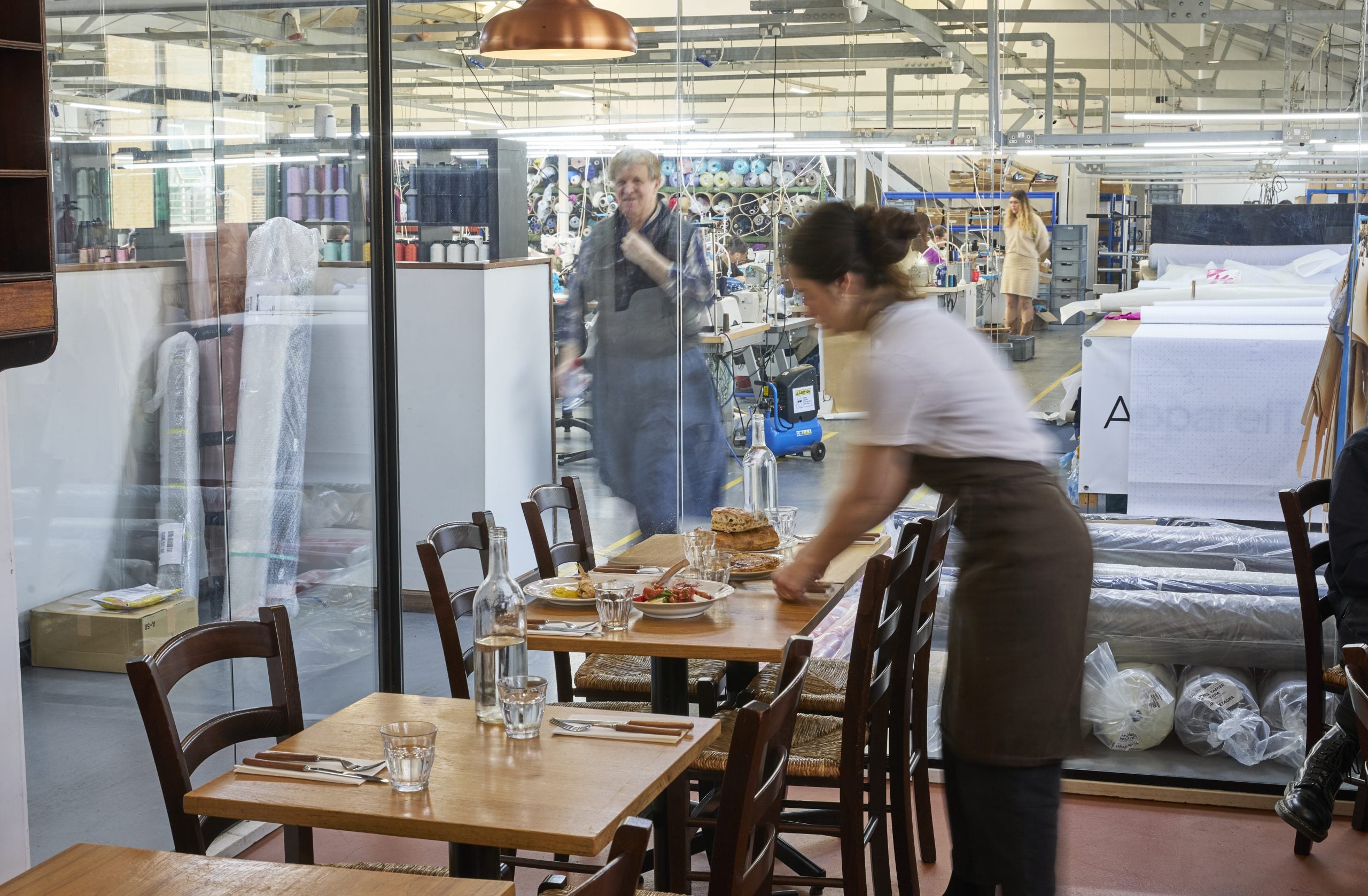
Zack Sartor, now Massarella's fiancé, moved his clothing manufacturer business Apparel Tasker into Bowood House around five years ago, and the new factory location came with a canteen, a space which provided Massarella with the blank canvas for Polentina. The restaurant still doubles up as the Apparel Tasker staff canteen during weekday lunchtimes. What may shock first time visitors to the restaurant, once they have actually found it, is that the division between Polentina and the factory floor is a glass wall, with an intimate eatery on one side and rows of sewing machines on the other.
“We didn’t open this to be some trendy place, it was because the space was here. Some people came here thinking it was a TikTok trap," says Massarella. "I like that it’s a bit hidden, because it makes the journey feel a bit more worthwhile."
Seasonal eating
If anything proves that Polentina is not a gimmick, it's the food.
“None of our dishes look that beautiful, they’re traditional, home-cooked – you may well scroll past them on Instagram," says ex-professional photographer Massarella.
"We tried to steer away from dishes that people know – there are so many people doing carbonara, which isn’t bad, but it does mean that you don’t learn about other regional dishes."
Her paternal grandmother is from Frosinone, and though she emigrated to Canada when she was very young, her adherence to traditional Roman cookery was a major influence.
"My love for polenta comes from my grandmother, even though she’s from Frosinone. In Rome they make the polenta, spread it onto a wooden board, and top it with the sauce of sausage and pork ribs. When I was younger I didn’t realise it was a very northern thing. I think a lot of people think of polenta as boring, but it needs a little bit of love to be great."
In the case of the titular polenta at Polentina, it is enhanced with the addition of buckwheat to bring a nutty quality.
The menu changes every three weeks, and the restaurant has a number of diners (many of whom are Italian) who will regularly visit to try the new dishes. For them, it is a chance to explore more obscure regional dishes from other parts of Italy. One example Polentina has served previously is Veneto's sopa coàda, stuffed and braised pigeon which is then pulled apart, mixed, layered with crostini and cooked in its own broth. Massarella shares that one guest from Veneto was tempted but did not order it as he was due to have it that Christmas when he returned to Italy.
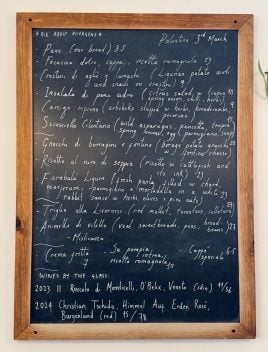
Massarella also nods to the other side of her family, which is Austrian and German, during the winter months with the likes of schnitzel, goulash and canaderli.
Offal in East London
One special dish that sets Polentina apart from London's countless other Italian restaurants is the Roman classic pagliata, the intestines of milk-fed veal which are then cooked to effectively become a ricotta sausage.
"We change the menu every three weeks, so we try to get pagliata on a couple of times a year. We have a supplier that we can consistently get it from, but to find that supplier took me years. In Rome they hold on to that ‘quinto quarto’ culture," she says. "People really enjoy it. It’s a hard sell at the start, but if you tell them it’s a funkier, iron-ier ricotta, they order it. When it mingles with the tomato sauce and guanciale, it’s an incredible dish."
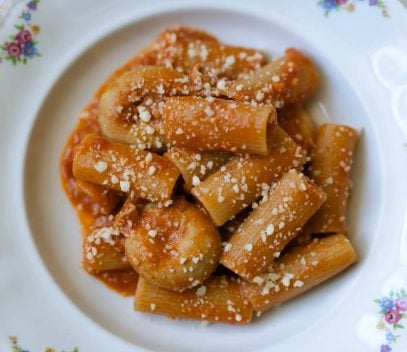
Polentina's pagliata.
Although offal is a traditional component of British cooking and has been celebrated by acclaimed London chefs, most famously Fergus Henderson of St. John fame, getting Brits to try the neglected cuts can prove challenging.
“We had a Ligurian zuppa di trippa on the menu recently. We cooked it for an event where it sold well, then we ran it on our menu in the restaurant and we sold two bowls in a week. It’s definitely more of a hard sell for British people. The smell and taste is a very particular thing. Nervetti salad sells a bit better as although it is gelatinous and chewy, it has a less intense flavour," Massarella explains.
Of course the irony is that many diners who might otherwise turn their noses up at offal will gladly fork out for thymus glands and pancreases, AKA 'sweetbreads', or 'animelle' in Italian. Polentina has a suitably spring-like dish of sweetbreads with peas and broad beans.
The wine list
Perhaps just as divisive as offal for some diners is the idea of natural wine.
"We had some very natural, very wild wines on our list at the start," Massarella shares. "We have since toned it back. They're all still low-intervention and from small producers, but there are fewer 'funky East London orange wines'."
Much like the menu, the wine list adjusts with the seasons, with more bottles from Lazio in the summer and expressions from Burgenland in the winter.
The list is largely Italian, Austrian and German, reflecting Massarella's heritage, with the odd foray into Alsace as the wines of that slither of Eastern France "feel more Germanic and really sing with the food".
There is also the occasional Italian 'big hitter', like a Barolo or a Brunello di Montalcino, but Massarella points out that they aren't necessarily easy to sell: "It’s tricky here as these wines come with such a pricetag that they sit in our storage for a while. People question why they would buy a £100 bottle of wine while sitting in a factory in East London! But if it’s a good bottle of wine it shouldn’t matter where you are."
Plans to expand?
Given the restaurant's popularity and the confined space it occupies, Massarella has considered changing location, but, for now, Polentina will be staying put.
"A year ago I was on the hunt for something else because there wasn’t much space to grow into here. But it came to the point when I thought ‘why don’t we just stay and put our mark on it?’ For the time being it makes sense to be here."
Polentina's Bow location is also an asset when it comes to the cost of running the business.
"The rent here is nothing in comparison to a high street location in West London. It does make it tricky to get enough covers, so you’re constantly catching your tail," says Massarella. "Even if you’re doing simple Italian cooking, you have to charge certain prices. The amount of prep that goes into these dishes is incredible, it’s very labour intensive."
In an era when even a plate of pasta can become a social media stunt in the hands of some London chefs, Polentina's restraint and elegance make it a breath of fresh air. We often talk about Italian cuisine as being about respecting great ingredients with simple but sublime recipes, but there aren't many restaurants in the British capital that do it so skilfully.
"It fell into my lap, I have always loved cooking but I never would have thought that I would open a restaurant. It felt organic though: I open when I want to open, I cook the dishes I want to cook, and it feels like cooking for extended family."
 The Italian restaurant inside a clothing factory in London
 Equalitas, exports and breaking the rules – why Casale del Giglio works
 'You have to let British people fall in love with Italy'
 Why ABFV Italy chose a quarry for its new Bolgheri winery
 Casa Vinicola Coppi pays tribute to its founder with forgotten grape variety