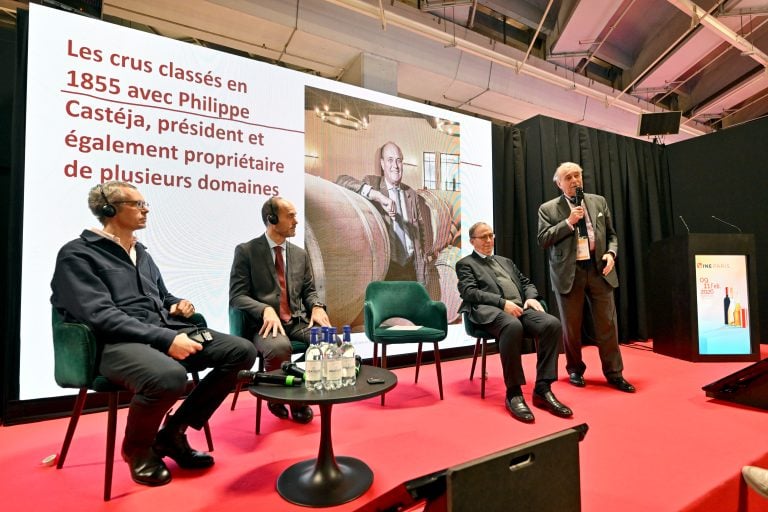
"Sometimes we place the New World against the Old World," opened Bernard Burtschy of the Fédération Internationales des Journalistes et des Écrivains du Vin (FIJEV). “In the Old World we have a long tradition – Champagne, Burgundy and Bordeaux have been wine regions since the middle ages. There were lots of copycats, in the Old World there were restrictions on production, on terroir. But appellation doesn’t mean quality."
The panel, Appellation Leadership: Staying a Benchmark in a Changing Wine World, was organised by FIJEV and featured representatives for three of Europe's most-famed wine regions – Bordeaux, Cava and Bolgheri – and asked the question of how Old World appellations might retain their place in what is a rapidly-changing wine market.
Bordeaux and the role of tradition
Providing a Bordelais perspective was Philippe Castéja, president of the Conseil des Grands Crus Classés, the association which promotes and defends Napoleon III's 1855 Classification of Médoc and Sauternes wines.
“The Chamber of Commerce in Bordeaux decided to grade the wines and send the finest wines to the Universal Exhibition in Paris. The ranking was made in a fortnight, based on tasting notes and prices/rates on the market. Five categories for reds, two for whites," Castéja explained.
This system helped some producers who are among the most prestigious in Bordeaux today to weather the subsequent crises.
“At the end of the Phylloxera crisis, the owners of graded wines realised the importance of the system as it provided a reference for consumers," said Castéja. “We don’t know how strong or lucky we are to have this. All over the world this is the best assessment tool we can have."
The producers in that 1855 Classification – including First Growths such as Château Mouton-Rothschild and Château Haut-Brion – were used in what remains the most famous blind tasting in wine history: 1976's Judgment of Paris. Although the French wines famously lost to their American counterparts in that benchmarking exercise, the former have still retained their allure 50 years on.

Philippe Castéja. Image credit: Sebastien d'Halloy.
“Excellent products will remain excellent, and there will always be consumers for them – it’s different for cheaper wines, of course. Tastes are changing – Gen Z are not the same consumers as Gen Y or Baby Boomers, it’s completely different. We went from the Sunday roast chicken with wine, taking time, to a generation that has lunch standing up with an Uber-delivered meal," Castéja argued. "There are also markets to be discovered, for instance in India they don’t drink wine the same way we do in Europe, so of course you have to understand that it’s a different story."
Cava and the quest for quality
Across the Pyrenees in Spain is DO Cava, a traditional method sparkling wine powerhouse making 200 million bottles a year with production zones across the country, though its heart is very much in Catalunya.
"To talk about Cava, and appellations in general, is about getting back to history – origins and terroir, we are talking about our DNA," commented DO Cava secretary general Alexandre Comellas. "We have reached a high level of globalisation - more tan 70% of our wine is exported, and we are present in more than 150 countries. It is difficult to convey a message to so many countries, so we wanted to reflect on the storytelling of Cava."
One relatively new innovation in the region has been the introduction of the Guarda Superior category to provide a further tier of quality.
"There were some expectations for Guarda - these products needed to come from specialised wines, 100% organic, so in terms of yield it should be a better quality yield, and the vine should be at least 10 years old," Comellas shared.
Bolgheri and the importance of openness
Compared to Bordeaux and Cava, Bolgheri in Tuscany is a new kid in the Old World of wine, with the Consorzio per la Tutela dei vini DOC Bolgheri only founded in 1995.
Among its members is Orma, the Bolgheri winery of Tenuta Sette Ponti. Export and communications director Alberto Moretti Cusetti joked: “In Italy we are lucky we are not a bigger country, because we produce so many wines already!"
“If we talk about Bolgheri we have to say 'thank you' to Sassicaia," noted Cusetti, citing Tenuta San Guido's legendary Bordeaux blend. "We [Tuscany] had a very bad reputation 30, 40 years ago – Chianti was pushing very cheap wine in the US, but Chianti Classico has done some great work...Bolgheri is a very strong DOC today, even if it is so tiny that we produce half a million bottles. We are trying hard to become the first totally organic appellation."
Although the 'Super Tuscans' have truly cemented their place in the fine wine market, Cusetti pointed out that these wines being Tuscan, Italian or indeed European in origin is no guarantee of commercial success – what is needed is a more 'hands-on' approach to marketing: “Today we are zero in the world because in many places they can make very good wine - of course, Bordeaux made the history, but with the new generation we need an experience. We are Italian, so we like to host people. The big challenge is to invite people to your place and make the experience unique so they remember you in the future."

Bernard Burtschy. Image credit: Sebastien d'Halloy.
Panel host Burtschy from FIJEV concurred, suggesting that "for some, 'marketing' is a swear word, but you need a strategy."
Burtschy concluded by espousing the notion that traditional European hospitality will be what continues to preserve wine's place on the dinner table: "We need to re-introduce the idea of friendliness and being together. That’s what the world of wine is all about!"
 Gaja unveils 2023 vintage of Camarcanda
 'It’s not about pushing your own agenda and your own taste'
 Certification, sustainability and sparkling wine: Enrico Serafino's story
 'Old vines are a fundamental part of the identity of this wine'
 The Italian restaurant inside a clothing factory in London