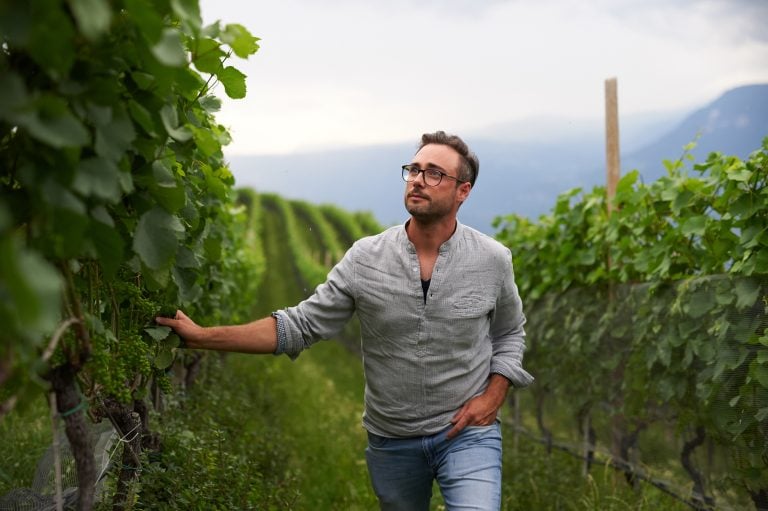
"The introduction of the 86 UGAs marks a decisive step for Alto Adige as a wine region. For the first time, the region formally acknowledges the diversity of its landscapes, soils, exposure and microclimates through a legally defined system. This creates a shared language for origin, allowing producers to express place more precisely and helping consumers understand why wines from Alto Adige can differ so markedly within such a small geographic area," says Cantina Kurtatsch president Andreas Kofler.
Although Alto Adige is relatively small in size, with its wine growing area roughly equivalent of Saint-Émilion on Bordeaux's Right Bank, the division of it into 86 Unità Geografiche Aggiuntive/UGAs is part of a desire to produce wines "with a clear sense of origin," in Kofler's words. However, for Cantina Kurtatsch, this commitment does not represent a philosophical shift.
"Long before the UGA system was formalised, we focused on site-specific viticulture and on expressing the individuality of our vineyards," says Kofler. "Today, we are proud to be a leading producer in Alto Adige with nine UGA wines originating from eight different UGAs. Five of these are even mono-varietal, meaning that only one grape variety is eligible to carry the name of the UGA when cultivated within that specific UGA."
The development of the UGA system
While scientific developments in the field of soil analysis have facilitated the creation of this terroir mosaic of Alto Adige, Kofler is adamant that the system is founded upon the experience of the region's producers above all else.
"It must be emphasised that today’s UGA classification is first and foremost built on decades of hands-on experience and continuous observation across a wide range of different terroirs. In Alto Adige, systematic experimentation with different grape varieties and sites only began in the 1980s," he says. "This long phase of learning was essential to understand how individual varieties respond to different soils, altitudes, exposures and microclimates, and to identify where they truly perform at their best. Without this accumulated experience across the region’s diverse terroirs, the UGA system would not have been possible. The primary foundation of the classification therefore remains the practical knowledge of agronomists and winemakers."
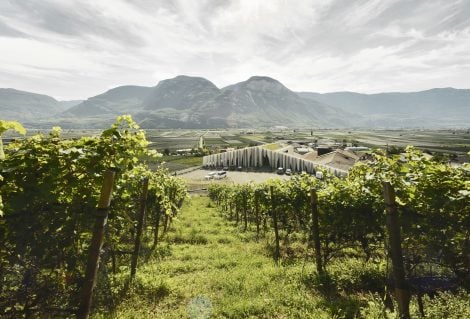
Image credit: Oskar Da Riz.
"It is this combination of experience, terroir knowledge and modern technology that makes the UGA classification robust, further strengthened by its historical grounding: historical cadastral maps dating back to the land register created by Maria Theresa dating back to the mid-18th century were used as the basis for defining the names of the individual geographical units," he adds.
UGA advantages
For a premium producer like Cantina Kurtatsch, the creation of a UGA scheme adds that extra stamp of quality that flags the wine's value to the consumer.
"Worldwide, the foundation of high-quality wine is always the combination of grape variety and site. Without this precise match, all other quality measures lose their effectiveness. Clearly defining vineyard sites and assigning the varieties best suited to them is therefore the basis of serious quality winegrowing. For consumers, the UGA classification concept provides a guarantee that years and decades of experience and commitment stand behind wines from Additional Geographical Units, and that they can be confident that the fundamental principles of quality viticulture are firmly in place, even further strengthened by the requirement for lower yields," notes Kofler.
"The major step forward lies in clarity. Through the official UGA symbol, the UGA system clearly distinguishes between wines with a fantasy name – which can of course also be of high quality – and wines that come 100% from a clearly defined Additional Geographical Unit, backed by clear guarantees: a precise combination of UGA and variety based on decades of experience and scientific analysis, as well as strictly regulated, lower yields. This transparency is a decisive improvement, sharpening identity, strengthening trust and elevating the overall perception of quality."
Penon-Kofl
One of Cantina Kurtatsch's expressions from a specific UGA is an Alto Adige Sauvignon DOC from Penon-Kofl.
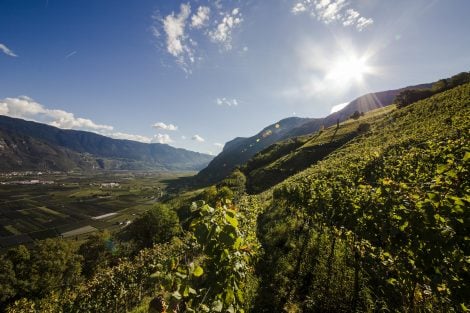
Penon-Kofl UGA. Image credit: Florian Andergassen.
"Penon-Kofl combines altitude, limestone-rich soils and excellent ventilation, creating ideal conditions for Sauvignon Blanc. 'Kofl', in the Alpine area of German-speakers, means 'mountain knoll'. The proximity of the steep slopes to the westerly mountain range guarantees an early sunset," shares Kofler.
The character of the UGA, which is located in the Cortaccia sub-zone in the south of Alto Adige and lies 422 to 614 metres above sea level, gives a unique quality to its Sauvignon Blanc, which is the only variety permitted within the UGA, if a wine is to be labelled as Penon-Kofl.
"The evening fall winds provide important cooling of the delicate grapes, preserving aromatic precision and acidity, while the high share of limestone in the porous soil rich in dolomite contributes structure and minerality. These conditions allow the grapes to reach full physiological ripeness, resulting in a Sauvignon profile without green or pyrazinic notes. Instead, the wine expresses refined, thiol-driven aromas, while retaining a vibrant acidity and freshness. The result is a complex Sauvignon with longevity, marked by characteristic clarity and balance."
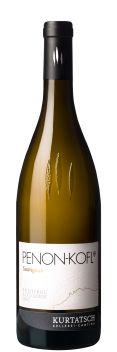
After a brief period of maceration, vinification takes place in stainless steel and large oak barrels to balance texture with fruit character. The wine is then aged on the lees in concrete for 12 months, further bolstering the body and palate of the wine.
Creativity versus regulations
Although this new system is comprehensive, it is not set in stone and can change.
"We already work with eight UGAs, covering a substantial part of the potential within our growing area," Kofler points out. "For the majority of the grape varieties cultivated at Cantina Kurtatsch, we already produce a wine from an Additional Geographical Unit, reflecting our long-standing focus on origin-driven quality. At the same time, by its very nature, the UGA system cannot be rigid and has to be regularly reviewed, as it is influenced by a range of external factors such as climate change. Over the long term, this may lead to shifts in combination of UGA and variety, for example, or to the need to move some varieties to higher altitudes."
Kofler does not see the restrictions that come with the UGA regulations – such as which grape varieties are permitted – as an obstacle to making exciting wines which captivate in the glass.
"For us, working with UGAs is not primarily about creativity, but about precision and attentive, site-driven work. Each vineyard sets a clear framework – our role is to listen, to understand its conditions and to translate its expression into the bottle as faithfully as possible. This means working with what a UGA naturally offers, adapting our decisions throughout the growing season, identifying the ideal harvest window and applying a gentle, site-respectful approach in the cellar."
When you drill down to it, it's all about terroir.
"This path inevitably comes with challenges, but ones we are more than willing to embrace," he concludes. "The reward is wines with a genuine sense of place – wines that reflect our terroir and are therefore truly distinctive."
 Wine is changing its place at the table
 The Rioja you don’t expect: whites that keep pace with the reds
 The soul of Maratea amid crystal clear sea, monuments and breathtaking views
 How Amarone changes its skin
 From the distillery to the global market: the numbers and identity of an Italian brand