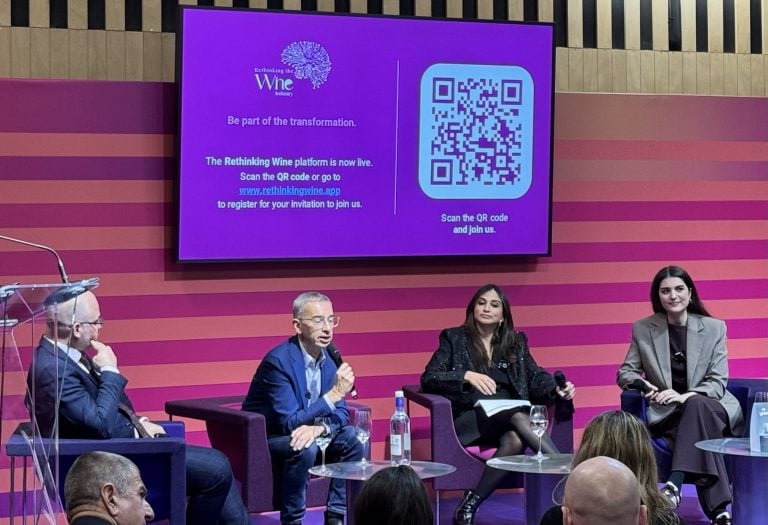
"Over the last two years we have known that we need to change approach, think about business models. We live in a world of uncertainties. We need to find how to be adaptable to these environments," opened panel host Priscilla Hennekam, the Brazilian-Australian founder of Rethinking the Wine Industry, which started as a WhatsApp group and a LinkedIn movement and has grown into a networking platform.
“Why are we doing the same things again and again if they are not working?," she asked. “If the wine industry keeps doing the same things, where are we heading?”
Stagnation
The panel was unanimous in its verdict that global wine is drifting in the doldrums.
“We all know that if the industry doesn’t change, it won’t crash, but it will face difficulties – upstream with viticulture and downstream in consumer needs," remarked Gregoire Letort, an entrepreneur and investor in WineTech. "There’s a lot of pressure to make the wine, and then they need to sell the wine, but there are a lot of products on the market that you can replace wine with."
Júlio César Kunz, vice-president of Associação Brasileira de Sommeliers (Association of Brazilian Sommeliers) and a trained psychoanalyst, suggested that there is a fundamental unknowability to the question of the direction the sector is heading towards: "If it was 10 years ago, my answer would be not where it [the wine industry] is going, but rather that it is staying where it is – that’s the problem; the world is moving, the consumer is moving. One thing that should be of concern is that in moments of uncertainty there are many prophets and many people with too much certainty. We should embrace the unknown, there are many possibilities."
The role of technology
In an era of artificial intelligence and the dominance of social media, it might be suggested that the future lies in technology – but the panel was not so certain.
Letort was scathing about the squandered potential of one wine app in particular: "The biggest wine community in the world is probably Vivino users, but it’s empty. It could have brought enthusiasts and amateurs together, but users only use it to check ratings. The point of community is not there."
"Many companies are trying to develop AI sommeliers, but this is very complex to do and it takes years. It’s not personalised enough. The tech is not at the level it should be yet, AI is in its infancy," he continued. "If you know how to play the algorithm of TikTok, Instagram or Amazon. Those algorithms change every few months, so you need to find ways to reach customers without burning a lot of cash."
"Technology doing nothing is worse than it doing something bad, because if it does bad you change it to be better," commented Kunz.
The importance of experience
What the panellists did agree upon was that wine can serve as a kind of escape from digital isolation. Among those espousing this view was Yolanda Martínez, a 24-year-old wine marketing strategist who tried to give a Gen Z perspective: "People in the industry are not looking at how we [Gen Z] interact. The world is changing so fast - the way we connect, interests - the industry keeps doing exactly the same. They need to listen to us - social media, Instagram, TikTok. We are supposed to be the loneliest generation because we are always on our phones. Wine has the power to change that - making plans, sharing a bottle."
"Most consumers are not looking for wine, they are looking for the experience wine makes them feel," she suggested. "Most producers are selling a bottle, a grape, a terroir, but consumers are looking to have a good time, they want to feel something."
The sentiment of wine as a "social beverage", one that should be consumed in the company of others and in a spirit of "togetherness" is certainly an appealing one for marketeers – but it begs a critical question: how can brands actually give consumers what they want?
Plugging the gap
Hennekam posed the idea that there is a division between what wineries are selling and what people are buying.
Kunz noted that this dislocation is not an easy fix: "If you try to close the gap, you either try to transform yourself or what the consumer wants, so you lose identity. But don’t tell consumers they don’t ‘understand the concept’."
Indeed, although the wine industry has tied itself in knots over what consumers – especially younger consumers – want to drink if they drink at all, Letort pointed out that the range of wines available on the market has never been greater and more diverse: "In 2026 we have so much choice to drink. 20 years ago it used to be traditional and intimidating, now I can have an orange natural wine from Georgia followed by a classic Burgundy. Gen Z is bringing diversity of offering and diversity of storytelling. People love craft, they don’t want industry, they want authenticity. The chance the industry has at the moment is that authenticity. The difficulty some winemakers have is being so rooted in tradition that they cannot transition to this new offering."
Adhere to or break from tradition?
Those two ends of the winemaking spectrum cited by Letort – one being old school fine wine and the other new wave natural wine – does raise the issue of whether wine brands should lean towards tradition, or veer away from it altogether.
Image credit: Philippe Labeguerie
The panellists agreed that wineries must "stop doing the same thing", and Martínez and Letort both cited a need for stylistic experimentation and the maintenance of a human touch.
"We need to start getting out of our comfort zone and be more experimental. Hire young people who bring new perspectives. Keep the passion – that is the most amazing thing about this industry and will keep it alive," said Martínez.
Singling out the example of a Bordeaux producer who now makes a non-alcoholic wine, Letort concurred with Martínez: "Experiment with the type of wine. Keep the human factor – wine is made by people, not machine."
Kunz meanwhile suggested that traditional views of wine should be maintained – especially the notions of 'terroir' and regional specificity.
“Keep the concept of terroir – it’s the best source of authenticity and diversity," he argued. "Stop thinking that the wine has a value in and of itself. Remember that each tradition in a wine region is because people used to love it, they discovered something that no-one else did and fell in love."
 Wine is changing its place at the table
 The Rioja you don’t expect: whites that keep pace with the reds
 The soul of Maratea amid crystal clear sea, monuments and breathtaking views
 How Amarone changes its skin
 From the distillery to the global market: the numbers and identity of an Italian brand