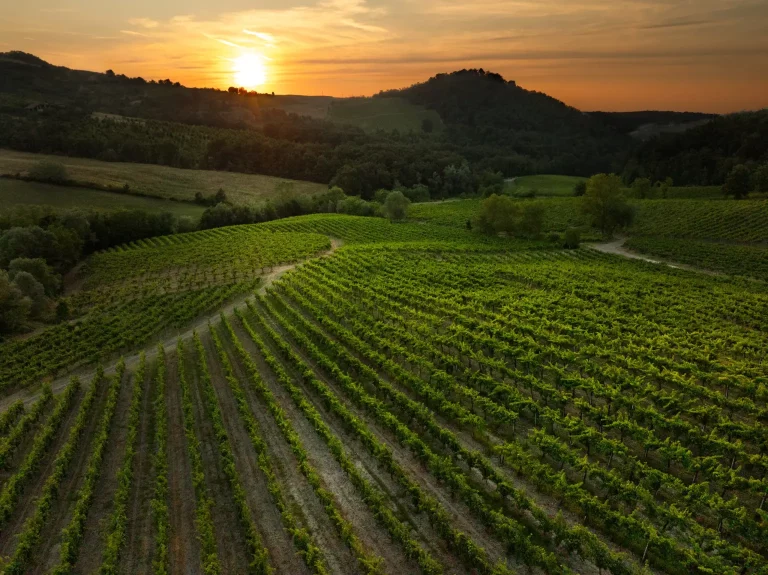
A historic milestone sees Pinot Noir overtaking the traditionally dominant red varieties in Oltrepò Pavese. The figures confirm that the new direction taken by the appellation’s governing body — first with the appointment of president Francesca Seralvo and then with the arrival of director Riccardo Binda — and its strategic focus on sparkling wines are fully aligned with what is actually unfolding across the territory.
In concrete terms, the revival of Classese (now adopted as a consortium brand, pending its recognition as a fully fledged appellation) brings back to the fore Oltrepò Pavese’s great sparkling-wine heritage, a legacy also confirmed in the vineyards. Italy’s first traditional-method sparkling wine was born in the Scuropasso Valley in the mid-19th century: initially as the source of Pinot Noir for sparkling bases, and soon after with the creation, in 1865, of Count Vistarino’s blanc de noirs. A tradition that in 1984 took the name Classese — Classico Pavese — whose new labels will be unveiled next April at Vinitaly.
Most-planted grape varieties
The latest data from the consorzio record, across a total vineyard area of 11,539 hectares, a clear predominance of Pinot Noir with 2,869 hectares (24.9%). This grape is destined both for traditional-method sparkling wine production (under the new regulations, Classese) and for Oltrepò Pavese DOC Pinot Noir. It is followed by other red varieties: Croatina with 2,846 hectares (24.7%) and Barbera (13.6%). Among white grapes — which account for 33% of the total — Pinot Grigio (11.7%) and Riesling Italico (7.4%) prevail.
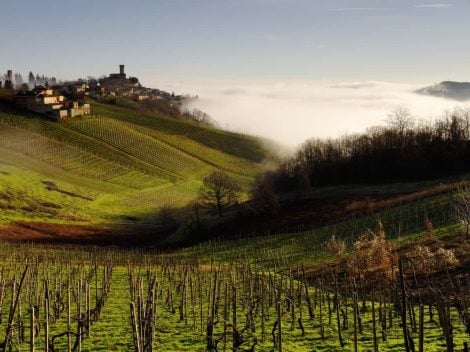
Oltrepò Pavese has thus become, in every sense, the homeland of Pinot Noir.
Viticultural mapping
Territorial mapping further shows that 98% of vineyards in Oltrepò Pavese fall under DOC or DOCG status, with DOCG alone accounting for 38% of the total.
The municipalities with the largest vineyard surface areas are Santa Maria della Versa (9.6%), Montalto Pavese (7.5%), Montù Beccaria (7.4%), Borgo Priolo (6.8%) and Montecalvo Versiggia (5.7%). Looking instead at the two most widely planted varieties, Pinot Noir is found primarily in Montalto Pavese (304 hectares), Montecalvo Versiggia (217 hectares) and Borgo Priolo (216 hectares), while Croatina is concentrated in Santa Maria della Versa (300 hectares), Montù Beccaria (295 hectares) and Rovescala (278 hectares).
The average vineyard altitude is 231 metres above sea level, but it easily reaches 631 metres for vineyards claimed as DOCG and as much as 770 metres for those under IGT designation. This clearly highlights the area’s territorial capacity to respond to rising average temperatures.
 Wine is changing its place at the table
 The Rioja you don’t expect: whites that keep pace with the reds
 The soul of Maratea amid crystal clear sea, monuments and breathtaking views
 How Amarone changes its skin
 From the distillery to the global market: the numbers and identity of an Italian brand